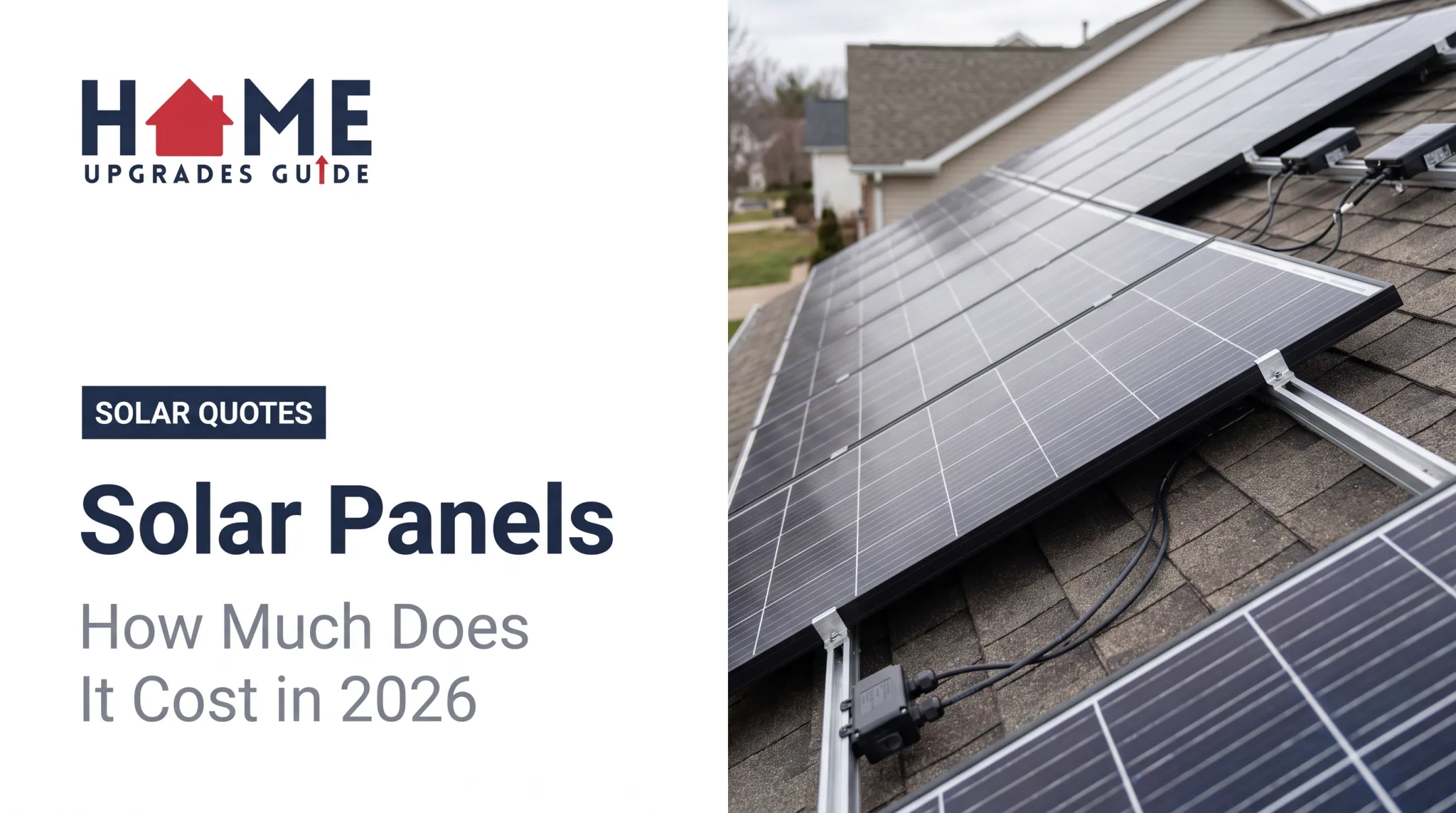

Add in a major shift for 2026: the federal tax credit that used to shave 30% off installations for homeowners who own their system no longer applies to new installs. That changes the math for nearly everyone shopping right now.
This guide breaks down real 2026 pricing data, shows you how systems are actually priced, and flags the costs people tend to miss. You'll also get a practical way to budget based on your own electricity use, not a generic "average home" figure.
Key Takeaways
- Installed residential solar typically runs $2.56 to $2.78 per watt before incentives, depending on system size.
- Final cost depends on system capacity, roof and electrical work, equipment, labor, and local market conditions.
- Homeowners with simple roofs and no electrical upgrades usually land at the lower end of pricing.
- The lowest bid isn't automatically the best deal. Production estimates and warranty terms matter just as much.
- The federal 30% homeowner credit ended for installations placed in service after December 31, 2025.
How Much Do Solar Panels Cost in 2026? (Pricing Overview)
There's a difference between a panel's price tag and what you'll actually pay for a working system on your roof. Panels themselves are a small slice of the total bill. Inverters, racking, wiring, labor, permits, and inspections make up the rest.
According to EnergySage's 2026 report, the solar-only median installed price sits at $2.62 per watt, based on marketplace-quoted pricing before incentives are applied. That figure excludes battery storage and reflects quotes, not a survey of completed installs. Treat it as a planning benchmark, not a guarantee.
Costs by System Size
Here's how pricing breaks down across common residential system sizes, based on EnergySage's 2026 marketplace data:
| System Size | Gross Installed Cost | Price per Watt | Best Suited For |
|---|---|---|---|
| 5 kW | $13,900 | $2.78/W | Small homes, low usage, partial offset |
| 10 kW | $25,800 | $2.58/W | Average single-family homes |
| 12 kW | $30,720 | $2.56/W | Larger homes, EV charging, heat pumps |

Notice the price per watt drops as system size increases. Fixed costs like permitting, design, and the service call itself get spread across more capacity, so bigger systems often cost less per watt even though the total bill is higher.
Worked example: A 10 kW system priced at $2.58/W comes to 10,000 watts × $2.58 = $25,800, before incentives, batteries, or any roof work. That's your starting point, not your final invoice.
System size should match your annual kWh usage, not your square footage. If you're planning an EV purchase or a heat pump conversion, size up now. Retrofitting a system later usually costs more than building in extra capacity upfront.
Panel-Only vs. Installed-System Pricing
A single panel is cheap. SolarReviews puts the hardware cost at roughly $200 per panel as of October 2026. That number only covers the module, not installation.
In the context of a full project, modules typically represent about 12% of total installed cost, or roughly $0.36/W, according to SolarReviews' October 2026 cost model. The rest covers:
- Inverter and racking hardware
- Electrical work and wiring
- Labor and design
- Permitting, inspections, and interconnection fees
- Installer overhead and profit
Buying panels separately won't shrink your project budget much, and it can create headaches: mismatched warranties, compatibility issues with your inverter, and permitting problems if the equipment isn't on your installer's approved list.
Key Factors That Affect Solar Panel Cost (and the Full Breakdown)
Every solar quote reflects two cost categories. Hard costs cover physical equipment and labor. Soft costs cover design, permitting, sales, interconnection, and business overhead. Soft costs often make up more than half the bill.
System Size and Equipment Quality
Your system size depends on annual kWh usage, roof orientation, shading, and local sunlight hours, not home square footage. Oversizing wastes money upfront. Undersizing leaves you still paying a meaningful utility bill.
Equipment choices also affect price:
- String inverters are the most affordable configuration.
- String inverters with power optimizers cost more than basic string systems but less than microinverters.
- Microinverters usually cost the most but can help with shaded or complex roofs.
Higher efficiency panels and premium warranties cost more upfront. Higher upfront cost does not always mean better value. Compare degradation guarantees, expected production, and manufacturer track record instead of chasing the biggest name on the spec sheet.
Roof, Property, and Electrical Conditions
Roof complexity drives cost beyond what a basic quote often shows. Multiple roof planes, dormers, skylights, steep pitch, and difficult access all add labor hours. Ground mounts and detached structures add trenching and extra equipment.
If your roof is older, get it inspected before installing. Removing and reinstalling panels later for a roof replacement typically runs $1,500 to $6,000, and can exceed $7,000 depending on system size, according to EnergySage's roof-replacement guide.
Electrical panel upgrades and service changes are common, site-specific add-ons. Confirm whether your home's electrical panel can handle the new system during your initial assessment.
Location, Labor, and Incentives
Local labor rates, installer competition, and permitting procedures all shift pricing from one metro area to another. So do state incentive programs, which change frequently and vary widely:
- California: Export compensation under the Net Billing Tariff usually runs below retail rates for new interconnections.
- Pennsylvania: Systems up to 50 kW qualify for net metering with full retail-rate credits for excess generation.
- Florida: Solar systems are exempt from state sales and use tax.
- New York: A state tax credit covers 25% of qualified costs, capped at $5,000.
- New Jersey: State program data shows an average residential capital cost of $3.66/W among recently accepted projects.
- Maryland: Income-eligible homeowners can access a rebate of $750/kWdc, capped at $7,500.
- Delaware: Utility grants offer $0.80/W up to $10,000, capped at half the project cost.
On the federal side, the IRS confirms that the residential credit no longer applies to homeowner-owned systems placed in service after December 31, 2025. Always verify current program rules through your state energy office or DSIRE before assuming a discount applies to you.
Additional Costs People Often Forget
Several project costs sit outside the base installed quote:
- Battery storage: A typical 13.5 kWh battery runs $15,647 installed, before incentives, per EnergySage's battery guide.
- Ground mounting: Averages $2.96/W for a 14.7 kW system, roughly $43,571 before incentives.
- Main panel upgrades, roof repairs, and tree trimming: Priced separately and highly site-dependent.
Some of these are optional. Others, like electrical upgrades needed for code compliance, aren't.

Low-Cost vs. High-Cost Solar Systems: What's the Difference?
A lower quote isn't automatically a worse deal. Price gaps usually reflect what's included and how the equipment is configured.
Performance and Equipment
Lower-cost systems often use standard string inverters and mid-tier panels, which work well on simple, unshaded roofs. Higher-cost systems may add microinverters or power optimizers, which help with partial shading or multiple roof orientations.
Premium equipment doesn't guarantee proportionally greater savings. Compare projected production numbers for your specific roof, not generic marketing claims.
Durability, Warranties, and Service
Before comparing prices, compare what each quote protects you against:
- Workmanship warranty length and what it covers
- Product warranty on panels and inverters
- Production guarantees tied to actual output
- Who handles service calls after year one
A lower bid that skips roof flashing work or a necessary electrical upgrade can end up costing more once those gaps surface.
Financing and Long-Term Value
How you pay changes your total cost more than most homeowners expect:
| Structure | Who Owns It | Cost Exposure |
|---|---|---|
| Cash | Homeowner | Upfront price, no interest |
| Loan | Homeowner | Principal + interest, often ~7.5% median rate |
| Lease | Provider | Fixed monthly payment, may escalate |
| PPA | Provider | Per-kWh charge, may escalate |
Many leases and PPAs escalate 1% to 3% annually over 20-25 year terms, according to EnergySage's financing comparison. EnergySage's H1 2026 data found prepaid leases running 39% cheaper and prepaid PPAs 57% cheaper per kWh than cash purchases in some markets. That doesn't make financing universally better. It depends on your contract's fine print.
Before signing anything, get these terms in writing:
- Cash price and financed total
- APR and fees
- Escalation clause
- Home-sale transfer terms
How to Estimate the Right Solar Budget
Skip the "average home" math. Your budget should come from your actual electricity use and your roof's specific conditions.
A Practical Estimation Process
- Pull 12 months of utility bills and calculate your total annual kWh usage.
- Factor in future changes like an EV purchase or switching to heat pump heating.
- Assess your roof, including orientation, shading, age, and available space.
- Estimate system size using your annual usage and local production assumptions for your area.
- Apply a current price-per-watt range to get your gross installed estimate.
- Adjust for extras, batteries, roof work, financing costs, and available incentives.

Comparing Quotes Accurately
Get at least three written proposals and compare them on the same categories:
- System size and estimated annual production
- Equipment models and warranties
- Gross price and financing totals
Quotes that skip any of these details are harder to trust.
HomeUpgradesGuide can save time here. You can request free project quotes, compare matches from vetted local contractors, and decide whom to contact and when, with no obligation attached.
Return on Investment and Affordability
A worked example from EnergySage's payback analysis: a 12 kW system at $31,042, after a $2,000 local rebate, nets $29,042.
With roughly $2,500 in annual avoided electricity costs plus $322 in SREC revenue, the annual benefit is $2,822. That produces a payback of 10.3 years.
Those figures rest on specific local assumptions, not a universal number. Your payback depends on utility rates, export compensation, and financing terms. Compare lifetime cost and ownership structure, not just the monthly payment.
What Most People Miss When It Comes to Solar Panel Cost
A handful of blind spots cause the most budget surprises:
- Confusing gross price with net price. The sticker price, the after-incentive price, and the monthly payment answer three different questions.
- Missing exclusions. Confirm whether your quote covers roof repairs, panel upgrades, utility fees, batteries, and monitoring.
- Picking based on price alone. The cheapest system might be undersized. The priciest might include equipment you don't need.
- Skipping contractor vetting. Check licensing, insurance, workmanship coverage, and who's responsible for service after installation.
HomeUpgradesGuide's matching process walks through four simple steps: pick the project, share the details, enter your address, and compare matches from vetted local professionals serving your area. There's no obligation to call anyone until you're ready.
Conclusion
Solar panel cost in 2026 isn't one number. It depends on your system size, roof condition, local labor market, equipment choices, and how you finance the project. A smart budget weighs gross cost against lifetime cost and checks what's actually included in the quote.
Start by pulling your utility bills and noting any likely roof or electrical work. Then compare free quotes from local professionals matched to your address before signing anything.
Frequently Asked Questions
What is a good cost per watt for solar?
A "good" price per watt depends on your location, system size, roof complexity, and what's included in the quote. Compare several current, written proposals rather than anchoring to one national average.
How much does a 10k solar system cost?
Multiply 10,000 watts by a current price-per-watt range, roughly $2.58 to $2.78, for an estimate of $25,800 to $27,800 before incentives. Batteries, roof work, and financing can change the final total.
How much does it cost to run a solar panel?
Panels themselves have minimal operating costs, but the full system involves monitoring, occasional cleaning, inverter replacement, and possible loan interest. Budget for these ongoing costs separately from the installation price.
Is 5kW enough to run a house?
It depends on your annual kWh usage, climate, appliances, and whether you're charging an EV or running electric heat. Size your system from your utility bills, not your home's square footage.
How many solar panels do I need for 10,000 kWh per year?
Divide your required system capacity by your chosen panel's wattage. Local sunlight hours, roof orientation, shading, and system losses all affect the final panel count, so confirm assumptions with a local installer.
Will solar panel prices go down?
Module prices and complete installed-system prices don't always move together. Tariffs, labor costs, and the end of the federal homeowner credit all affect 2026 pricing. Compare current quotes rather than waiting on a forecast.