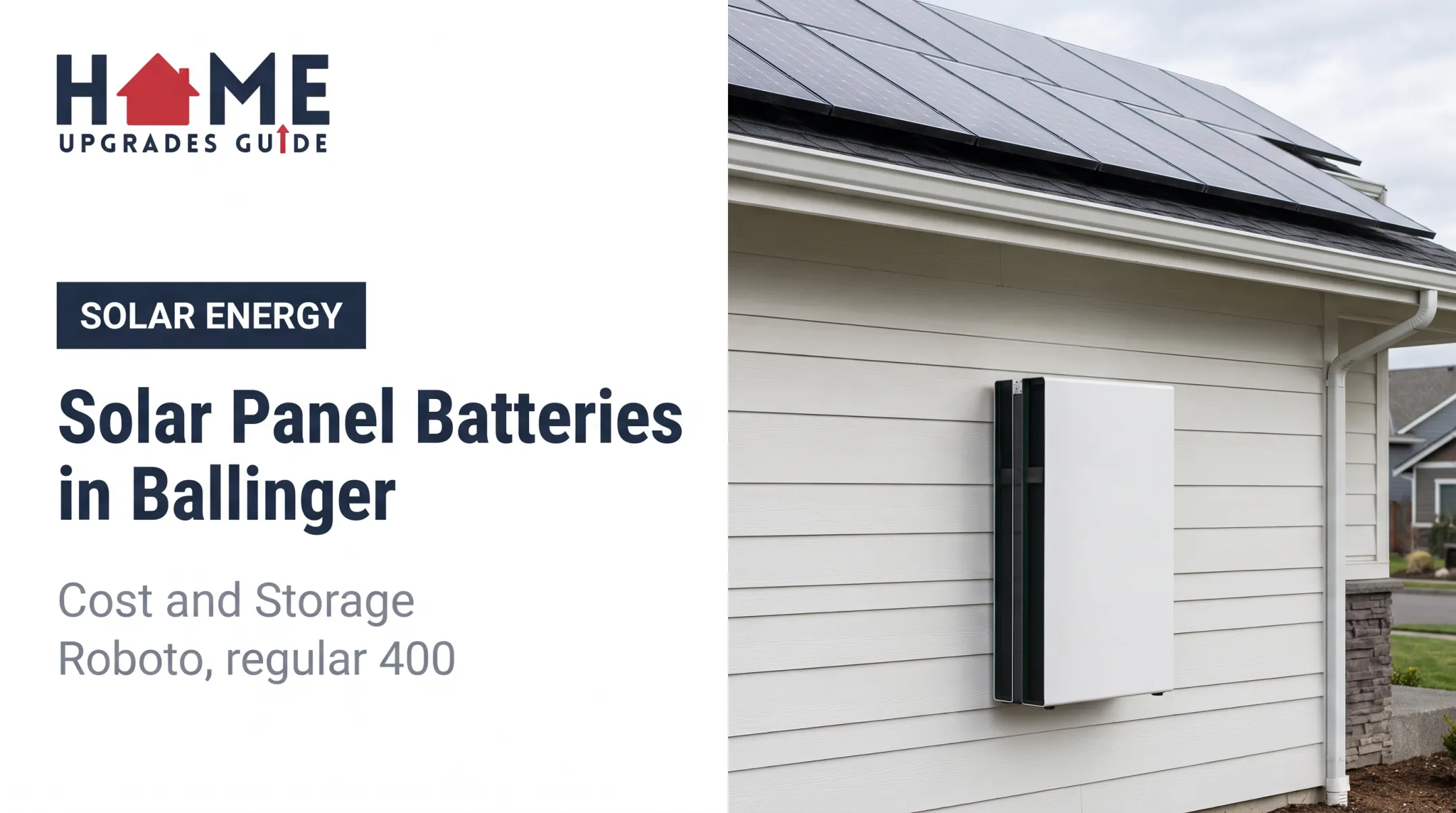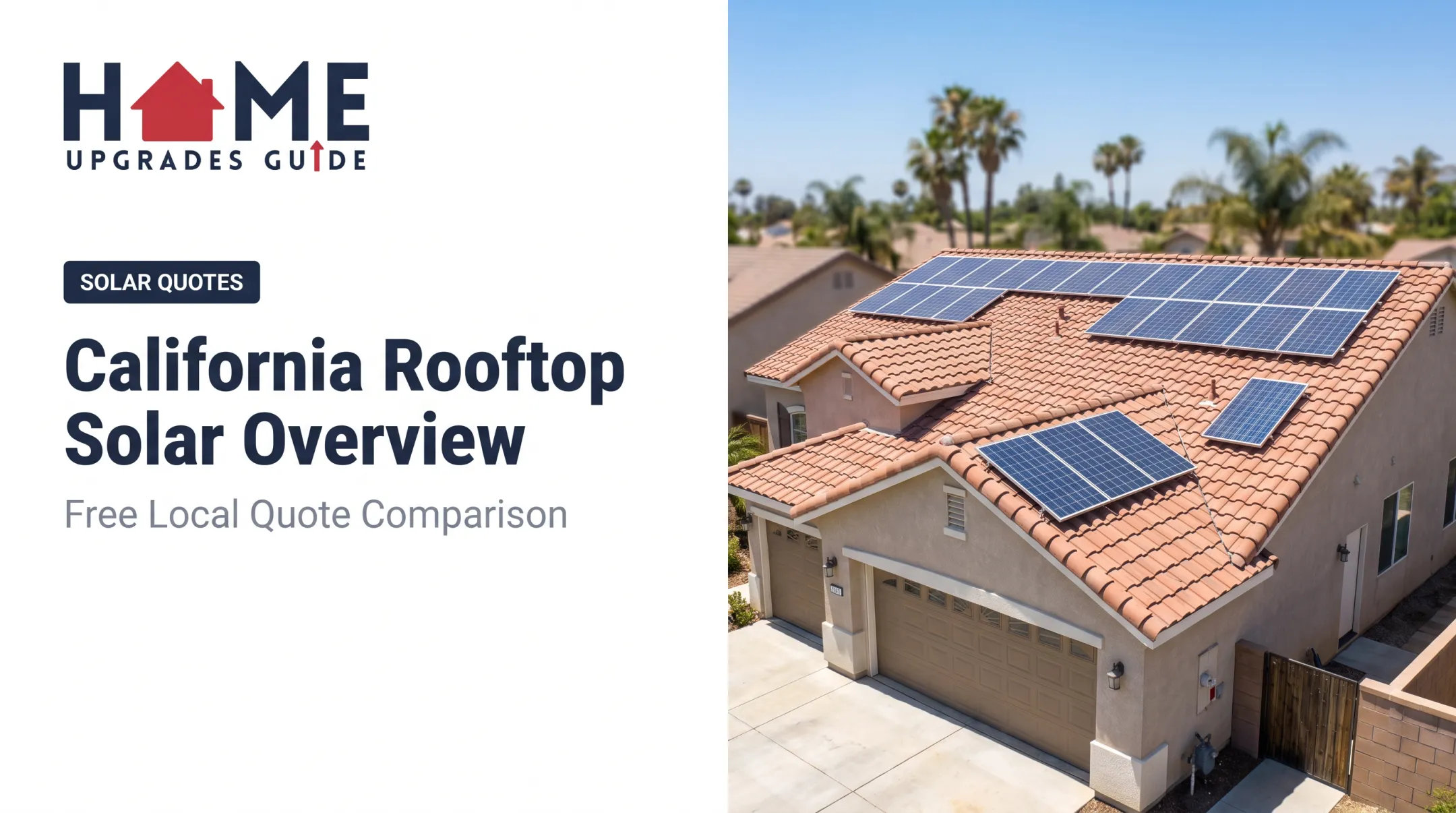

This guide walks through how batteries work, how California's net billing rules shape their value, what 2026 incentives and tax rules actually say, what installation costs look like, and how to size a system and compare contractor quotes without getting burned by vague promises.
Key Takeaways
- Storage serves three goals: lower bills, backup for essentials, and less grid dependence.
- Confirm incentive and tax rules with official state and utility sources before you sign.
- Compare usable capacity, continuous output, backed-up circuits, and warranty over sticker price.
- HomeUpgradesGuide lets you request free quotes and choose which contractors to contact, and when.
How California Solar Batteries Work and What They Can Do
The basic flow is simple. Solar panels generate electricity, your home's loads draw from that power first, and any excess charges the battery. Once the battery is full, additional solar either exports to the grid or goes unused, depending on your system's settings and your utility's rules.

Solar-plus-storage systems differ from grid-charged batteries. A battery paired with solar panels recharges for free using daytime sun, which matters both for daily bill savings and for recovering after an outage. A battery charging only from the grid still provides backup, but it won't refill itself during a multi-day blackout without sunlight.
Critical-Load vs. Whole-Home Backup
Not every outage is the same. Your backup configuration determines what stays on:
- Critical-load backup typically covers refrigerators, lighting, Wi-Fi equipment, and medical devices
- Whole-home backup can extend to HVAC, EV chargers, and electric cooking appliances, but requires more battery capacity and power output
Capacity and power output are two different things:
- Usable capacity (kWh): how long a battery can run
- Power output (kW): how many appliances can run at the same time
A battery with plenty of stored energy but low power output might still trip when your air conditioner and oven kick on together.
Backup duration isn't fixed, either. It depends on how charged the battery is when an outage starts, how much sunlight your panels get during the outage, which circuits are backed up, and how much your household consumes.
Tesla's own guidance notes that "whole-home" capability depends on the number of battery units installed and actual household loads. It is not a guarantee of unlimited runtime.
Why California Utility Rules Make Storage More Valuable
California doesn't have one statewide solar compensation rate, and that's the detail most online calculators skip. The CPUC's net billing framework applies to Net Billing Tariff (NBT) customers of PG&E, SCE, and SDG&E, and it generally values exported solar electricity below what you'd pay to buy power from the grid. That gap is exactly why storing power for later use often beats exporting it.
Export rules and peak TOU windows vary by utility:
| Utility | Export approach | Peak TOU window |
|---|---|---|
| PG&E | Hourly export values under Solar Billing Plan | 4–9 p.m. daily |
| SCE | Hourly generation + delivery credits | 4–9 p.m. |
| SDG&E | Hourly export pricing, no residential export adder | 4–9 p.m. |
| LADWP | Municipal net metering, credits carry forward | 1–5 p.m. weekdays |
| SMUD | Flat $0.0960/kWh export credit (effective June 2026) | 5–8 p.m. weekdays |
Your program status changes the math:
- NEM 2.0: Exports are generally credited near retail rates for the remaining years of your 20-year tariff
- NBT: Exports are priced using the state's Avoided Cost Calculator, usually lower than retail
- Export adder: PG&E and SCE customers who applied before certain deadlines get a nine-year adder; SDG&E customers do not
Check your interconnection agreement before assuming either scenario applies to you.
Illustrative example only: Say your panels export solar at a low midday rate but your evening import rate is three to four times higher. Storing that midday energy and discharging it during the evening peak can meaningfully reduce what you pay, after accounting for round-trip efficiency losses and gradual battery degradation. This isn't a universal payback calculation: your actual savings depend on your rate plan, usage pattern, and system size.

Beyond the math, batteries provide resilience during public safety power shutoffs, wildfire-related outages, and storm-driven grid interruptions. That backup value doesn't show up on a utility bill, but it matters to many California homeowners.
California Solar Battery Incentives, Rebates, and Taxes in 2026
SGIP: Published Rates Aren't the Same as Available Funding
The Self-Generation Incentive Program (SGIP) offers rebates for battery storage, but availability varies sharply by category and utility territory. Several legacy categories, including General Market and Equity Resiliency tiers, are closed as of late 2026.
The newer AB 209 Residential Solar and Storage Equity channel, aimed at income-qualified households, shows a mixed picture. Some utility channels are waitlisted. Others, like certain publicly owned utility pathways through SCE and PG&E, remain open with limited remaining funds.
Bottom line: a published incentive rate doesn't mean money is actually available. Always confirm reservation status directly with the program administrator before budgeting around it.
"Free" Batteries Usually Aren't Free
Programs marketed as offering free batteries typically fall into one of these categories:
- Income-qualified rebates covering most or all of the equipment cost
- Utility-sponsored virtual power plant (VPP) programs with upfront incentives
- Leases or power purchase agreements, where a third party owns the system
- Equity programs limited to specific income brackets or fire-risk zones
Ownership matters here. If a third party owns the battery, they (not you) typically receive any tax credit tied to it.
Federal and State Tax Treatment
The federal Residential Clean Energy Credit under Section 25D offered 30% back on eligible battery purchases, but the IRS now confirms that this credit doesn't apply to property placed in service after December 31, 2025. If you're installing in 2026, don't build that credit into your math. Verify current eligibility before assuming otherwise.
On the property tax side, California's active solar energy system exclusion under Revenue and Taxation Code Section 73 can cover storage installed as part of an active solar system, shielding it from new-construction reassessment.
That exclusion is set to become inoperative January 1, 2027, though systems qualifying before then generally keep the exclusion until a future change in ownership. Standalone batteries aren't automatically covered; confirm with your county assessor.
A handful of utilities also run VPP programs (PG&E-Tesla and SMUD-Tesla are examples) that pay homeowners for allowing limited battery dispatch during grid events. Payment structures, event frequency, and reserve requirements vary and change year to year, so review current enrollment terms before counting on projected income.
Solar Battery Cost, Sizing, and Equipment Considerations
What Installation Actually Costs
EnergySage's 2026 report puts the typical California installed cost for a 13 kWh battery system at roughly $13,958, with a range of $11,864 to $16,052 before incentives. That figure should include equipment, labor, permitting, and electrical work, not just the battery itself.
Several factors push costs up or down:
- Usable capacity and continuous power output needed
- Number of battery units required to meet your goals
- Condition of your main electrical panel
- Distance between the battery and panel (conduit runs add cost)
- Whether storage is installed with new solar or retrofitted later
- Indoor vs. outdoor placement and any detached-structure wiring
Sizing for Your Actual Goal
Sizing isn't one-size-fits-all. A household wanting basic bill savings needs a different setup than one wanting whole-home backup through a multi-day outage. Match your system to your priority:
- Bill savings: size around your evening peak-usage hours
- Critical-load backup: size around refrigerator, lighting, and internet equipment needs
- Whole-home backup: size around total household load, including HVAC and EV charging
- Large-load support: add capacity specifically for heat pumps, pool equipment, or EV chargers
Comparing Equipment
AC-coupled batteries work well for retrofitting an existing solar system, while DC-coupled or integrated hybrid inverters often suit new installations. Specs vary meaningfully between manufacturers:
| Battery | Usable capacity | Continuous output | Warranty |
|---|---|---|---|
| Tesla Powerwall 3 | 13.5 kWh (nominal) | Up to 11.5 kW | 10 years |
| Enphase IQ Battery 5P | 5 kWh | 3.84 kVA | 15 years or 6,000 cycles |
| FranklinWH aPower 2 | 15 kWh | 10 kW | 15 years or 60 MWh throughput |

The lowest sticker price isn't always the lowest total cost. Factor in financing interest, expected degradation, maintenance, and how long you plan to stay in the home. A good contractor proposal should break out equipment, design, permits, labor, electrical upgrades, incentives, financing, and estimated net cost as separate line items, not one bundled number.
How to Compare California Battery Quotes and Choose an Installer
A complete proposal should spell out exactly which circuits get backed up, how the system behaves during an outage, where the battery will be mounted, fire-code clearances, and the emergency shutoff location. It should also address utility interconnection, inspection timing, and permission-to-operate responsibility.
Before signing anything, run through this checklist:
- Confirm contractor licensing (C-10 for electrical, C-46 for solar with storage under 80 kWh) and insurance
- Ask for manufacturer-specific battery credentials and local permitting experience
- Request references from recent California installations
- Clarify who handles warranty claims and post-installation service
- Ask whether monitoring is included and what it covers
Ask directly whether quoted incentives are confirmed, pending, or merely estimated. Get written assumptions for tax treatment, utility rates, degradation rates, and any projected VPP payments. Verbal promises don't hold up later.
Compare at least two or three proposals built around equivalent specs: same usable capacity, similar output, comparable backup coverage. A $3,000 price difference often reflects different equipment, not just different margins.
This is where HomeUpgradesGuide fits in. Homeowners can request free, no-obligation solar battery quotes and get matched with vetted local contractors, comparing options before deciding who to actually talk to, with no spam calls or resold contact lists involved.
Decision framework: If backup needs or time-of-use savings clearly justify the cost, move forward. If incentive status or utility rules feel uncertain, gather more information first. And for anything touching your personal tax situation, talk to a qualified tax professional, not a sales rep.
Frequently Asked Questions
How do I get free solar batteries in California?
"Free" usually means income-qualified rebates, equity programs, utility incentives, or lease/PPA arrangements rather than no-cost ownership. Verify current eligibility, funding status, and who actually owns the equipment before assuming it's free.
Will there be a California battery tax in 2026?
This depends on what you mean — property tax reassessment, sales tax, and federal credit eligibility are all separate issues with different rules. Confirm current treatment with California and local tax authorities, and consult a tax professional for your specific situation.
Are solar batteries worth it in California?
It depends on your utility, rate plan, export compensation, outage risk, and available incentives. Financial payback varies widely; many homeowners value backup power and independence beyond pure dollar savings.
How many solar batteries do I need for my home?
Sizing depends on your essential loads, desired backup duration, daily energy use, and whether you want critical-load or whole-home coverage. A load analysis from a contractor is more reliable than estimating based on square footage.
Can I add a battery to my existing solar system?
Many existing systems can accept an AC-coupled battery, and some support compatible DC-coupled options. Check inverter compatibility, panel capacity, and interconnection requirements before installation.